The short version
- No US court or regulator has ruled that card rips are gambling. For now they're sold as e-commerce, which lets platforms operate in nearly every state without gambling licences or taxes.
- Most US gambling laws look for three things: you pay, chance decides the result, and you can win a prize of value. Critics say a rip with an instant cash buyback has all three.
- The platforms say you're buying a real card that you own, so there's no prize and no bet. Some add a free mail-in route, the same defence sweepstakes use.
- The live legal fights are over Whatnot and Fanatics Live card breaks, plus California's sports card grab bag law. Their outcome will shape how app rips are treated.
This is a plain English guide to the arguments, not legal advice, and we haven't used any rip platform for it. It draws on the platforms' own statements, the laws themselves, legal commentary and news reporting.
Card rip gambling test
Pick the answers that match a pack you've seen. The tool shows which parts of the usual three part test it meets.
A simplified version of the test most US states use. Laws differ by state and country, and this isn't legal advice.
The short answer
Legally, card rips are in a grey zone. They aren't licensed as gambling anywhere in the US, and nobody with the power to decide has called them gambling. That isn't the same as being cleared. Bank of America told clients this week that the legal experts it spoke to think the category is "on solid regulatory footing as long as the cards remain backed by physical inventory", while comparing the economics to "a slot machine". Both things can be true: the product is legal to sell today, and it's built on the same maths as a bet.
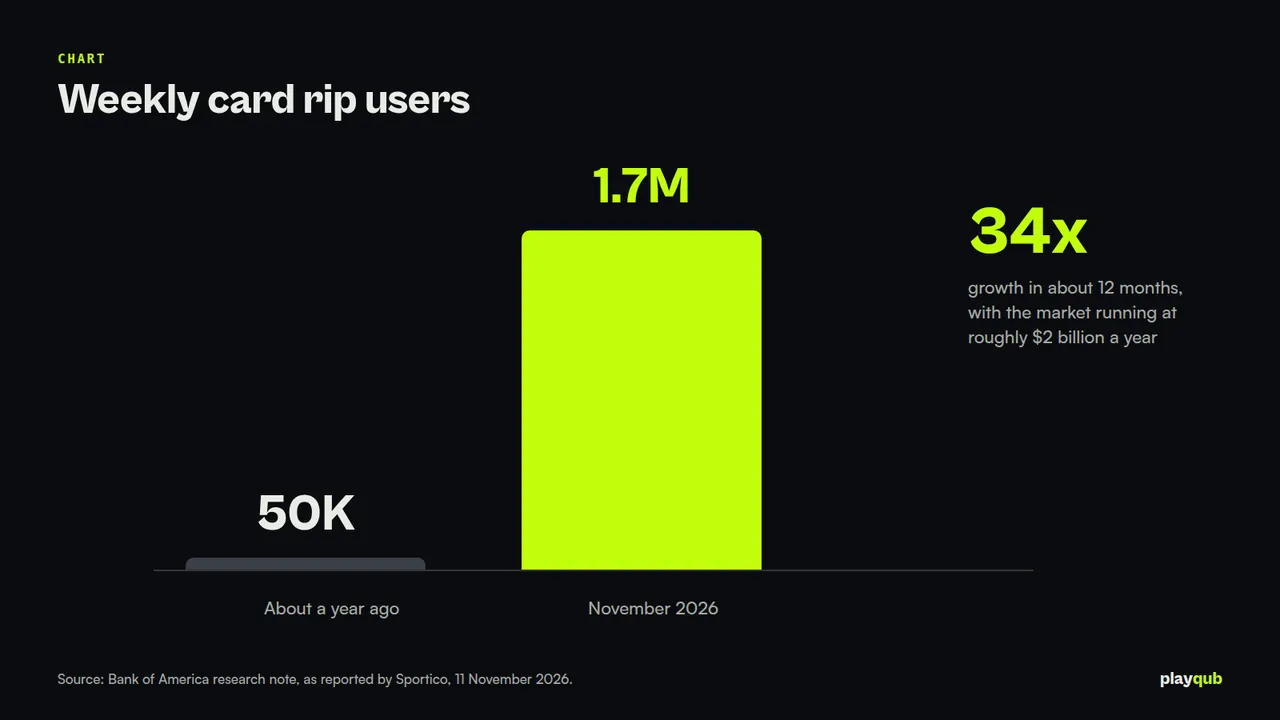
The size of the market is why the question matters. Bank of America estimates digital rips are running at $2 billion a year, with weekly users rising from about 50,000 to more than 1.7 million in roughly 12 months. Operators keep at least 6% of what's spent, according to the same report.
How card rips make money
This short video walks through the business model step by step: the vault of graded cards, the pack price, the buyback choice, the loop that sends most cards straight back to the shelf, and the slice the operator keeps on each cycle.
Read the transcript
Digital card rips are now a multi-billion dollar market. Here is how the money actually moves. It starts with inventory. The operator buys graded trading cards in bulk, locks them in a vault, and loads each one into a digital pack.
A player pays a fixed price, say $50. The pack opens and reveals one real card with its market value. Most pulls are worth less than the pack. A few are worth far more. Now comes the key decision. Ship the card home or sell it straight back for about 90% of its value. Almost everyone sells back. On one leading platform, 178 packs were opened for every card shipped. The credit buys the next pack, and the same card returns to the shelf.
Every cycle leaves a slice with the house. In July, the five largest blockchain platforms took in $284 million. They paid back $249 million and kept about $35 million. That engine needs a constant flow of new players and a small group of heavy spenders. Operators find them through ads, creators, free packs and referral races.
This is where an affiliate platform fits. It answers the brand searches and publishes odds, buyback rates and promo codes. Then it sends tracked players to operators, who pay per customer or a share of revenue.
One open question remains. US courts have not yet ruled whether this is retail or gambling, so build on data and stay ready for both answers.
The three part test
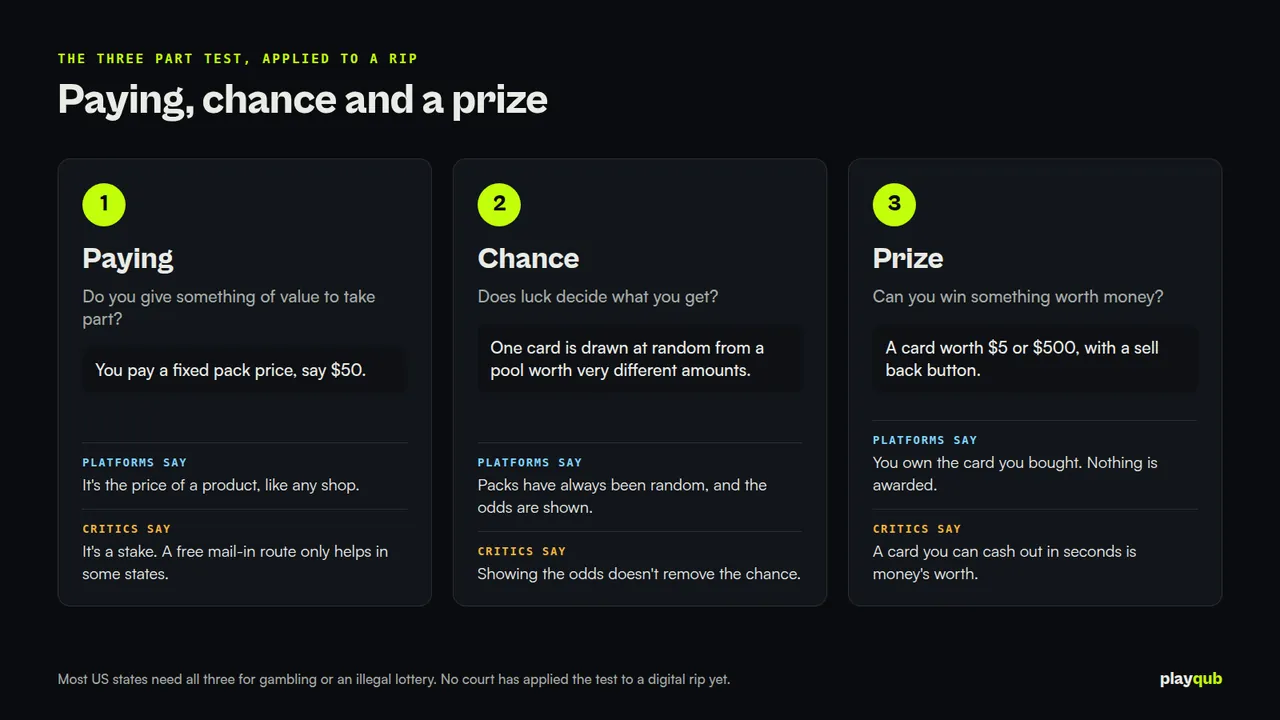
Most US states define gambling, or an illegal lottery, using three elements. All three have to be present.
- Consideration. You pay something to take part. With a rip, that's the pack price.
- Chance. Luck, not skill, decides the result. With a rip, the card is drawn at random from a pool of cards worth very different amounts.
- A prize. You can win something of value. This is where the argument sits. The card is real and can be sold, and on most rip platforms it can be sold back to the platform in seconds.
Ordinary sealed card packs have avoided being called gambling largely because the buyer always gets goods, whatever's inside. The law firm Womble Bond Dickinson makes that point in its note on the legal risks for repacks, adding that repacks draw more scrutiny because they're sold on "variable economic returns and high-value chase cards". Digital rips push that further, because the buyback turns the card back into money before the buyer has held it.
How often that happens is striking. Collector Crypt's chief executive told Barron's that as many as 98% of its cards are sold straight back, and blockchain data reviewed by the paper showed 178 packs opened for every card shipped over six months.
The platforms' case
The industry's answer is that a rip is a shop sale with a surprise inside. Rips by Triumph puts it most directly in its regulatory FAQ, updated on 3 November 2026: there's no "entry" because there's no contest, and no "prize" because "nothing is awarded contingent on an outcome". The cards you buy are the cards you get. It shows the odds and value range of every tier before purchase, checks ID before any payout, and sells everywhere in the US except Nevada. It says it doesn't offer a free entry route because, in its view, there's nothing to enter.
The Certified Trading Card Association, an industry group, made the wider argument in August: "Purchasing a randomized collectible product is not the same transaction as placing a wager." It compared rips to buying a box of cards worth less than you paid, which nobody calls losing a bet. It did accept that "rapid repeat purchasing, highly stimulating reveal experiences, immediate resale functionality and marketing focused heavily on financial outcomes" can affect how people behave.
Some companies hedge. Arena Club runs a free mail-in promotion, the "no purchase necessary" route that US sweepstakes use to remove the payment element. PrizePicks, which calls its Packs an e-commerce product, said it briefed state attorneys general and met gambling regulators before launch.
The case against
The best known critic is Leon Y. Xiao, an assistant professor at City University of Hong Kong who studies loot boxes and card packs. "I do think they are illegal gambling," he told the trade outlet InGame. "The law is just not enforced against them." Xiao is trained in English law and says he isn't a US lawyer, but he argues that many state laws work the same way, and that getting a physical card doesn't by itself take a product outside them. He goes further than most: in his view, ordinary card packs meet the legal definition in many places too.
Others draw the line at the buyback. The researcher Andrew Dagor has pointed to the in-app cash out as the feature that separates rips from traditional card buying. A pack from a shop gives you cards you'd have to sell yourself. A rip with a cash buyback gives you a price and a button.
The harm data is early but pointing one way. The addiction treatment provider Birches Health told Barron's it had seen a 207% rise in a year in patients mentioning trading cards and digital repacks. A survey of 1,961 players in six countries, published in Psychology of Addictive Behaviors, found spending on physical card packs was linked to problem gambling, though more weakly than spending on video game loot boxes. The gambling blocker Gamban has added Whatnot and Fanatics Live to its block list.
What the law actually says
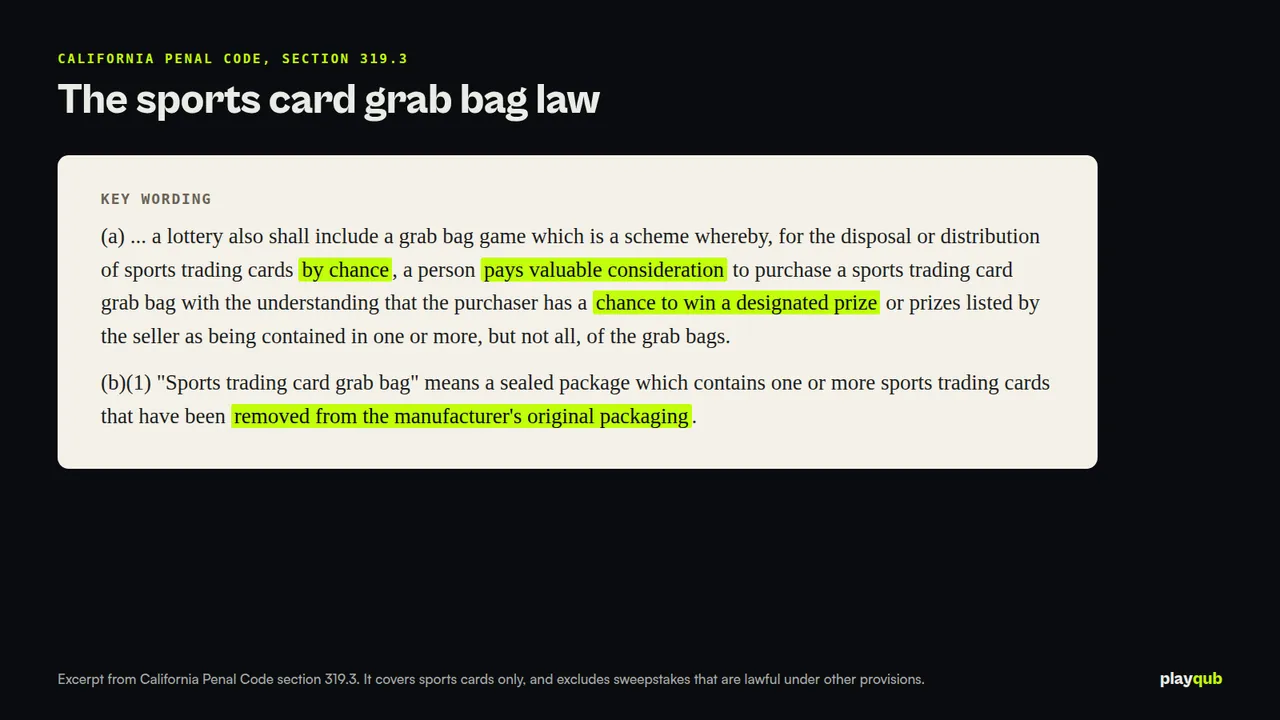
California has a law aimed at card repacks. Penal Code section 319.3 treats a "sports trading card grab bag" as a lottery. It defines that as a sealed package of sports cards "removed from the manufacturer's original packaging", sold with the chance of an advertised prize in some but not all bags. That wording fits repacks closely, but it was written in the 1990s for paper bags of cards, it only covers sports cards, so it doesn't answer the Pokémon question, and it doesn't reach factory sealed packs. Whether it covers a digital pack drawn from a vault is untested.
Free entry may not save a grab bag. The sweepstakes defence works for many promotions, but a legal commentary on grab bags in Legal 500 warns that card packs with a few valuable cards may be harder to protect with mail-in entries, especially in California.
Elsewhere, the general test applies. In most states the question falls back on payment, chance and prize, with the details depending on each state's lottery and gambling laws. The Texas raids this month show how prizes are judged in practice. The Bexar County sheriff's office raided seven alleged gambling rooms in San Antonio that paid out Pokémon and sports cards, which winners could sell for cash next door. Those were gaming machines, not rip apps, but Texas's exception for amusement machines caps a prize at 10 times the cost of a play or $5, whichever is less. Cards worth hundreds of dollars don't fit.
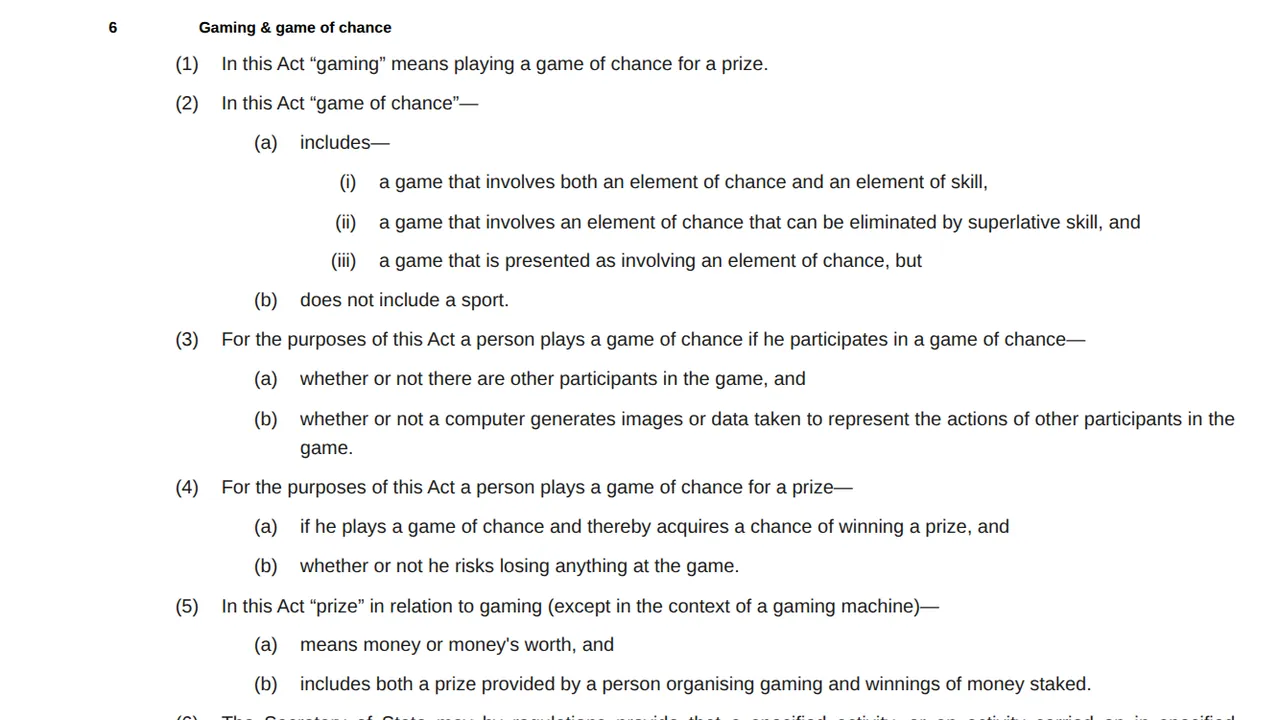
In Great Britain, the bar is lower. The Gambling Act 2005 defines a prize in gaming as "money or money's worth", and Xiao has said physical mystery slab products sold by UK retailers would breach it. The Gambling Commission hasn't acted against card products, and most rip platforms don't serve UK customers.
Cases to watch
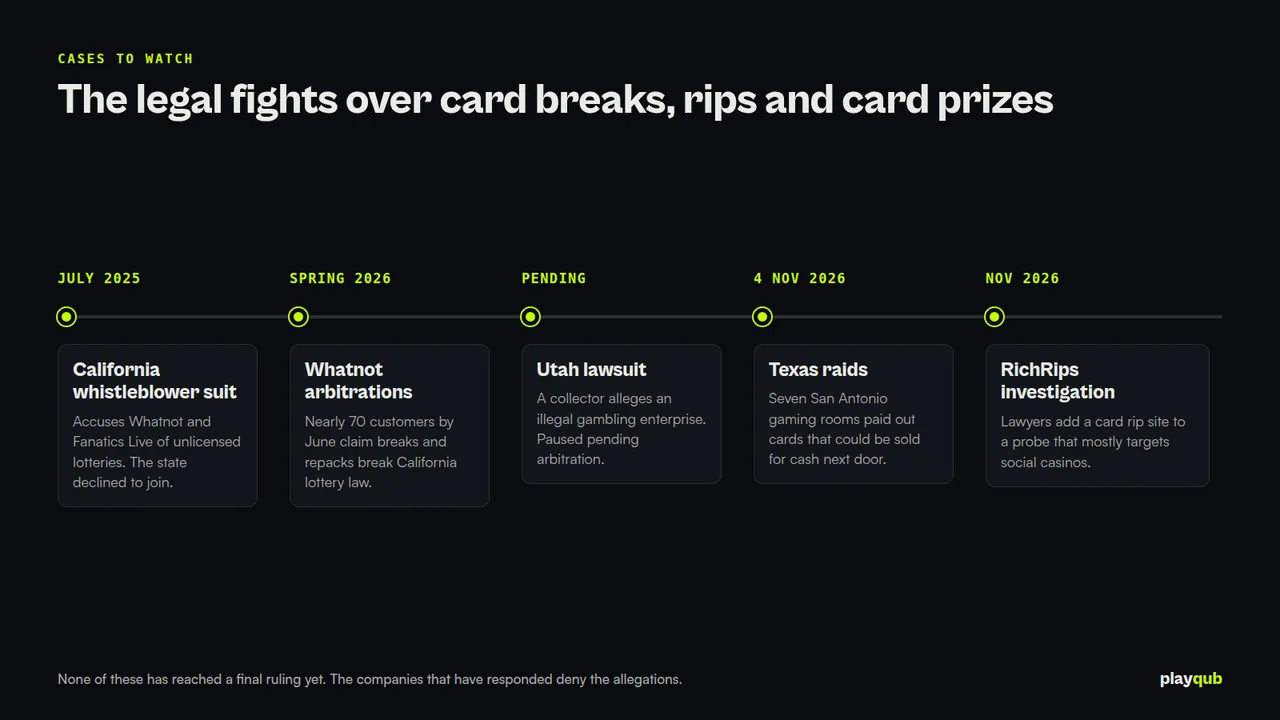
- Whatnot arbitrations. The lawyer Paul Lesko had filed arbitration demands for nearly 70 Whatnot customers by June, arguing that its card breaks and repacks break California's lottery laws. Whatnot denies it and says gambling isn't allowed on its platform.
- Utah. A collector, Kevin Parker, has sued Whatnot alleging an illegal gambling enterprise. The case is paused while an arbitrator decides whether it must go to arbitration.
- California False Claims Act suit. A whistleblower suit filed in 2025 and since unsealed accuses Whatnot and Fanatics Live of running "unlicensed box-break lotteries" and failing to pay gambling taxes. California's Department of Justice declined to join it.
- RichRips. In November, lawyers added the card rip site RichRips to an investigation that mostly targets social casinos, over possible breaches of state gambling and consumer laws.
- The regulators. California's Gambling Control Commission has said any ruling on card breaks would have to come from the state attorney general, and none has. Meanwhile FanDuel is testing rips through its rewards club and Crypto.com launched its own this week, so the companies with the most to lose from a ruling are also the ones moving in.
None of these cases is about an app rip. A ruling that card breaks or repacks are lotteries would still be the clearest signal yet of how the same arguments would land against a digital pack with a buyback.
What it means if you rip
- Treat it as gambling with your own money, whatever the label. On average you get back less than you spend, and most single packs return less than the average. Our guide to the big card rip platforms has a calculator for the cost.
- Check the age and location rules. The big apps are 18+ and several exclude certain states.
- Know what the buyback pays in. Cash, site credit and automatic sell back after a deadline are very different deals.
- Spending limits and self exclusion aren't standard on rip platforms the way they are at licensed sportsbooks. If you need a block, gambling blockers now cover some card sites.
- If spending on packs has got out of hand, the US National Problem Gambling Helpline is 1-800-GAMBLER. In Great Britain, the National Gambling Helpline is 0808 8020 133.
For pack opening with nothing real at stake, the Roblox card pack games keep every card inside the game.
Sources and method
Market size, user numbers, the 6% figure and Bank of America's quotes come from Sportico's report on the bank's note of 11 November 2026. The platforms' position is from Rips by Triumph's regulatory FAQ of 3 November 2026 and the Certified Trading Card Association's statement of 27 August 2026. The Collector Crypt buyback figures, the Birches Health figure and the 178 to 1 shipping ratio are from Barron's reporting in August 2026, as summarised by Gambling Insider. Xiao's comments are from interviews with InGame, Gambling Insider and Kanto Post. The Whatnot, Fanatics Live and regulator details are from Gambling Insider, ESPN and Womble Bond Dickinson; the RichRips investigation from ClassAction.org; and the Texas raid from the Bexar County sheriff's statements as reported on 5 November 2026. Statute wording is from California Penal Code section 319.3 and the UK Gambling Act 2005, section 6. The chart, diagrams and video are Playqub's own, built from these sources; the video's figures come from Barron's, Messari and Datawallet. The test tool is a simplified version of the three element test, not legal advice. Playqub has no connection with any platform named here.
Frequently asked questions
Are card rips legally gambling in the US?
Not officially, as of November 2026. No US court, state regulator or attorney general has ruled that digital card rips are gambling, and the platforms sell them as e-commerce in most states. The question is open, though: most state gambling laws look for payment, chance and a prize, and critics argue rips with instant cash buybacks have all three.
Why do card rip platforms say they aren't gambling?
Because every pack delivers a real card that the buyer owns and can have shipped. Rips by Triumph, for example, says there is no prize because nothing is awarded on an outcome, and the Certified Trading Card Association says buying a random collectible is not the same transaction as placing a wager. Some platforms also run a free mail-in route, the defence used by sweepstakes.
Are ordinary Pokémon or sports card packs gambling?
Regulators haven't treated sealed packs as gambling, mainly because the buyer always gets cards. Some researchers, including Leon Y. Xiao, argue that ordinary packs meet the legal definition in many places too and simply aren't enforced against. California's grab bag law covers sports card packs made from cards taken out of their original packaging, not factory sealed packs.
Is anyone suing card rip or card break platforms?
Yes, though mostly over live breaks and repacks rather than app rips. Nearly 70 Whatnot customers have filed arbitration claims, a Utah collector has sued Whatnot, and a California whistleblower suit accuses Whatnot and Fanatics Live of running unlicensed lotteries. Lawyers have also opened an investigation into the RichRips site. None has produced a ruling yet.
Can I use card rip apps outside the US?
Most rip platforms only serve US customers, and several block certain states. In Great Britain, the Gambling Act 2005 treats a prize as money or money's worth, and Xiao has said physical mystery slab products sold by UK retailers would breach it, though the Gambling Commission hasn't taken action on card products.
Facts in this article were checked against developer and store sources on 12 November 2026. Prices, versions and dates change, so confirm on the official page before you buy.