The short version
A voxel is one cell in a 3D grid, the way a pixel is one cell in a flat image. A voxel game stores its world, or part of it, in that grid, which is why you can usually dig into it, build on it or blow holes in it. Block games like Minecraft use big voxels you place one at a time. Games like Teardown use tiny ones so whole buildings can crumble realistically.
Voxels in one paragraph
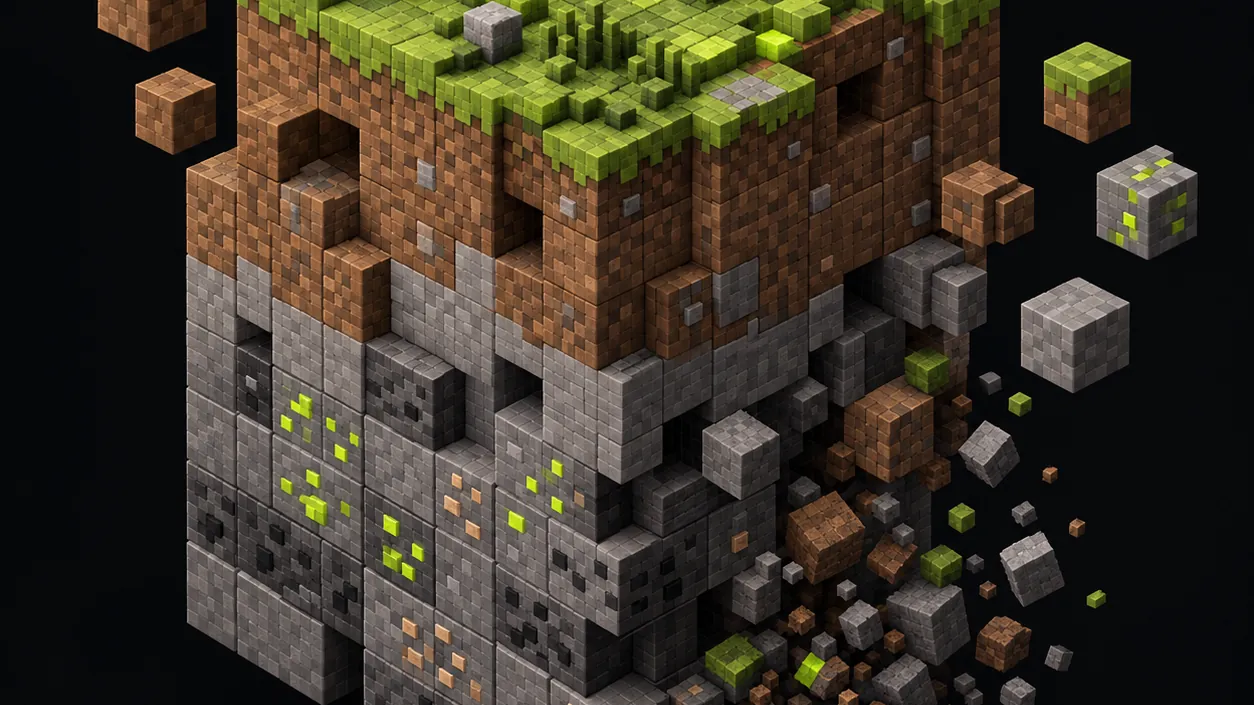
A photo on your screen is a grid of pixels, each holding a colour. Add a third dimension and you get a grid of small cubes stacked in rows, columns and layers. Each cube is a voxel, short for volume pixel. In a game, a voxel usually stores more than a colour: what material it is, whether it's solid, how much light it lets through. The key idea is that the world is made of addressable cells, so the game knows exactly what sits at any point, including inside a hill.
Why most 3D games are not voxel games
Most 3D games build their worlds from polygon meshes: thin shells of triangles wrapped around objects. A mountain in a typical open-world game is a hollow surface with a picture painted on it. There's nothing inside, so you can't dig a tunnel unless the developers placed one there in advance.
In a voxel world the inside exists. The hill is stone all the way down, with ore in some cells and air in others. Remove a cell and the game simply updates the grid and redraws that area. That one difference is what makes voxel games feel so open.
Block games versus true voxel games
People use voxel for two kinds of game that look quite different.
Block games
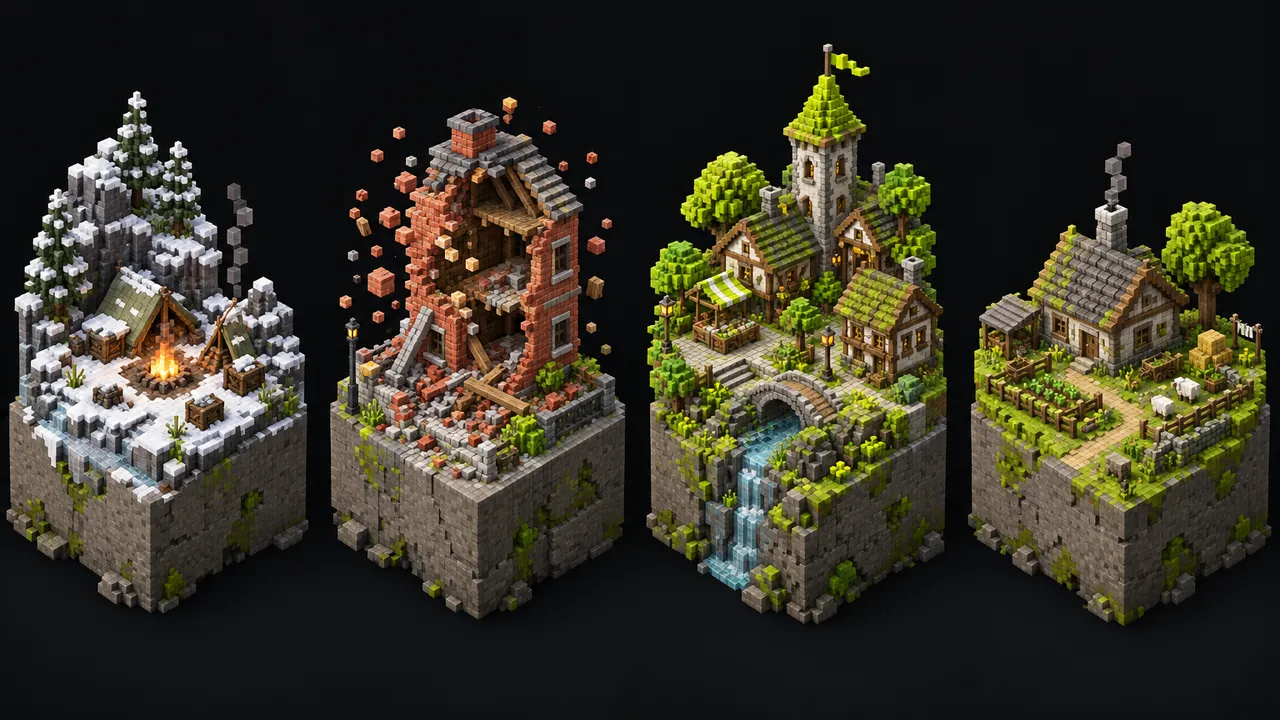
Minecraft, Luanti, Vintage Story and Hytale store their worlds as grids of large blocks, roughly a metre across. You interact with one block at a time. Under the hood, the game turns the visible faces of those blocks into polygons and paints textures on them, because graphics cards are very good at drawing triangles. So the look is polygons, but the world itself is a voxel grid.
Fine-grained voxel games
Teardown goes the other way. Its voxels are tiny, so a wall is made of thousands of them, and every one can break off, burn or fall. The result is destruction that feels physical rather than scripted: you can drive a truck through a building and the hole is the shape of the truck. The cost is that this takes far more computing work, which is why worlds in these games are usually smaller levels rather than endless landscapes.
| Block games | Fine voxel games | |
|---|---|---|
| Voxel size | About a metre | About 10 centimetres in Teardown |
| Typical world | Huge, procedurally generated | Handmade levels |
| How you change it | Place and remove single blocks | Break, burn and blast chunks |
| Examples | Minecraft, Luanti, Vintage Story, Hytale | Teardown |
Chunks: how huge worlds fit in memory
A world made of cells gets very big very fast. Voxel games deal with this by splitting the world into chunks, blocks of space that load when you're close and unload when you leave. That's why far-off terrain sometimes pops in as you travel, and why view distance is the setting that affects performance the most in block games.
Chunk shapes vary. Many games use tall columns that run from the bottom of the world to the sky. Others use cubes, which let worlds go much higher and deeper because only the part near the player has to be loaded. Hytale is moving its engine from columns to cubic chunks for exactly that reason.
What voxels mean for players
- You can change everything. Digging, building and terraforming are natural, not special features.
- Worlds can be generated. A grid is easy to fill with rules (stone below this depth, trees on grass, caves where noise says so), which is how block games create endless, unique maps.
- Modding is approachable. Adding a new block is often just a texture and a few properties, which is why voxel games have such large mod scenes.
- Performance has its own quirks. Huge builds, long view distances and lots of moving parts are what slow these games down, more than polished graphics.
Voxel art is related but different
You'll also see "voxel" used for an art style: models and scenes built cube by cube in editors such as MagicaVoxel or Goxel. These often end up as ordinary polygon models in games that aren't voxel games at all, chosen for the chunky, handmade look. If that side interests you, our comparison of free voxel editors is a good starting point.
Where to start playing
If you want to feel the difference for yourself, try one game from each camp. For blocks, Luanti is free and open source, and runs on modest hardware. For fine voxels, Teardown is the clearest example of what destructible worlds can do. Our guide to games like Minecraft covers more options by play style.
Steam lists over a thousand games under its Voxel tag if you want to browse further.
Frequently asked questions
Is Minecraft a voxel game?
Yes, in the sense that matters for players. Its world is stored as a 3D grid of blocks you can remove and place. It draws those blocks as textured polygons, which is how most block games work.
What does voxel stand for?
Voxel is short for volume pixel, or volume element. It is one cell in a three-dimensional grid, the 3D version of a pixel in a flat image.
Are voxel games always blocky?
No. Some engines smooth the grid into curved terrain, and games with very small voxels, such as Teardown, look detailed rather than blocky up close.
Facts in this article were checked against developer and store sources on 9 October 2026. Prices, versions and dates change, so confirm on the official page before you buy.